Thursday, January 20, 2011

The Rowboat

Mum, her dad and brothers (each kid with a turtle) in the rowboat about 1930.

I think it’s no mistake that cathedral arches and the prows of boats take the same shape. Both are structures of beautiful form following function, created to lift us through the stormy waves of life and keep body and soul afloat. I am not sure my father thought our old row boat was beautiful on the days he spent in the hot sun with it inverted on a pair of saw horses, laboring to patch it up for another season. Like Burt Dow’s colorful Tidely Idely, our vessel had a few “tender places” between her planks. She was a classic New England dory of some sort, happily retired to the tame, silky-warm waters of our southern New Hampshire Lake. Our boat was always referred to simply as the rowboat.
My father was an ocean boy, who grew up summering in Duxbury, Massachusetts. He had been in the Navy on a destroyer during World War II and was one of the few sailors on his ship who liked to swim off her side if the water was warm enough. Once he swam clear under the ship from one side to the other. After the Battle of Santa Cruz, he defied rules and jumped overboard to save a drowning seaman—probably not the best idea, as he was the ship’s chief engineer. The captain “balled him out,” then presented him with the ship’s flag, flown during the battle. He never told us the story until he was well up in his eighties, waking at night thinking he was still aboard the Mansfield.
Like Ratty in The Wind in the Willows, Daddy adored messing around with boats. He taught me to splice rope and let me help him make outhauls for our boats. He built us a raft complete with a narrow, canvas-covered, plank for a diving board which was conducive to games of pirates and Billy Goats Gruff. He made a ramp for our dogs to scramble aboard by, and maintained the raft with copious amounts of creosote every season. Still the rowboat was a challenge.
I have no idea how old she was. My mother, born in 1920, had grown up with her and I scarcely believe that my grandfather bought her new. By my era, the fifties, she may well have been half a century old. In any case, I have a vivid picture in my mind of Daddy blistering the paint off the bottom of the boat with some sort of electric paint-stripping tool. I can still smell the fumes, mixed with sun on pine needles, lake water, and sand. Then there were hours of hand scraping, sanding, and carefully packing the seams with oakum. At last, he would give her a new coat of white paint over the thick strata of many summers past, with perhaps a fresh layer of dark green for the inside as well. My brother, environmental journalist, Ted Williams, once wrote in Gray’s Sporting Journal that in her latter years our boat was probably more of a paint rowboat than a wooden one.
She was heavy. It must have been a job to wrestle her onto the sawhorses. Then she was dragged down to the water and launched for another summer. What a vessel for four kids! She had three plank seats that fitted into place, as well as a triangular built-in bow seat which was much fought over. She had floorboards which also fitted neatly into their appointed sections and which kept our bare feet out of the bilge. A few inches of water in the bottom was inevitable, no matter how carefully Daddy caulked her seams. This bilge was ripe with dead worms, soggy sandwich crusts, potato chips, rusty hooks, and the occasional bloated sunfish. After a rain, there was no choice but baling. Atlas himself could not have lifted the rowboat to dump her out once she was filled with water.
But the crowning glory of our boat was a spacious, built-in stern seat which curved along each side and boasted a dark, sloshy, and odoriferous well, perfect for storing bait, turtles, empty cans, or any flotsam and jetsam picked up on the lake. This stern seat easily accommodated an aunt or grandmother’s ample bottom as well as the smaller butts of several children, usually myself, my sister and a cousin or so.
Mummy liked to tell of the time her father (Baba to us) caught a snapping turtle by getting it to bite onto an oar. With thoughts of dinner, he argued the beast into the well and delegated his six year old daughter to sit on the cover. It was a scary ride home for little Mary Lou, seated atop an angry, thrashing turtle. It was fruitless to boot, as she always described the soup, boiled up after the turtle was given the coup de grace with a brush hook, as “vile.”
Our destination was usually “the swamp” which lay directly across the lake from our camp. Drew Brook winds under three small bridges before opening into a lovely little marsh as it flows into the pond. In the fifties when fewer camps had been built in wetland areas and weeds were not a problem, the water level was kept lower. It was low enough for us to enjoy a sandy beach at home and for the rowboat to bump and scrape—passengers crouching, eyes squeezed shut against falling flakes of rust and rotten wood—under the first two bridges.
We loaded the boat with fishing rods, shiner nets and pails, picnic lunch, butterfly nets, and most important for my sister and me—nets for catching turtles. Then we donned the cumbersome, many strapped, life jackets of the era which were about as comfortable as wearing an empty cider keg around one’s chest, and set off across the lake. I spent much of the voyage staring over the transom into the water. From the first dimly waving pondweed as we approached the sandbar, to the murky depths beyond the second bridge—which offered up hornpout, perch and the occasional trout—there was much to fascinate a kid.
We caught snappers and musk turtles, but the sought-after jewels were painted turtles. Maneuvering the rowboat through the weeds was heavy work. Mum had a bad back, but that didn’t stop her. She was as keen a turtler as we were. It was a matter of pride to be able to spot a yellow and black striped head among the myriad broken weed stubs glittering in the sun. There’s one . . . about ten feet away on the right . . . it just went under . . . I think it was a baby . . . wait . . . everyone be quiet . . . scoop under it . . . There! It might be a miss, or the net might be held triumphantly aloft containing a tangle of weeds and a frantically clawing turtle. One extracted, the turtle was passed around for all to admire its bright yellow plastron and gorgeous black carapace edged with red.
We kept our turtles as summer pets in a cage on our beach, to be released the morning we once again donned shoes and returned to school. It was a small comfort, as we faced another year confined to the classroom, to set something free. When my girls and their cousins were small, my sister and I took them up the inlet in kayaks and canoes, portaging over instead of under the bridges. We caught many turtles, but always let them go before paddling home.
The rowboat didn’t last forever, except in my memory. One year, Daddy gave up and purchased a noisy, nearly indestructible, maintenance-free aluminum canoe. On the Fourth of July he piled the rowboat with driftwood and brush, anchored her a hundred feet out from our dock, paddled out in the new canoe, and set her alight. She burned to the water-line on a summer night filled with fireflies, fireworks, and shooting stars. It was as fitting an end for her as a Viking funeral pyre. I remember a sense of honorable celebration more than sadness. The next day, my brothers towed the blackened ribs, which arched eerily up from her bottom, to the swamp--there to dissolve, like so much other organic matter, into the muck of the wet wilderness she had so often prowled.


Monday, December 13, 2010

Camp Dog, George

Here's a shot of my little dog, George, on the dock in the Adirondacks, learning "the ropes" of being a good camp dog. She's not really tied up with that big rope--it just looks that way! My August-October project was a chapter book called, Camp Dog George.  

Friday, December 10, 2010

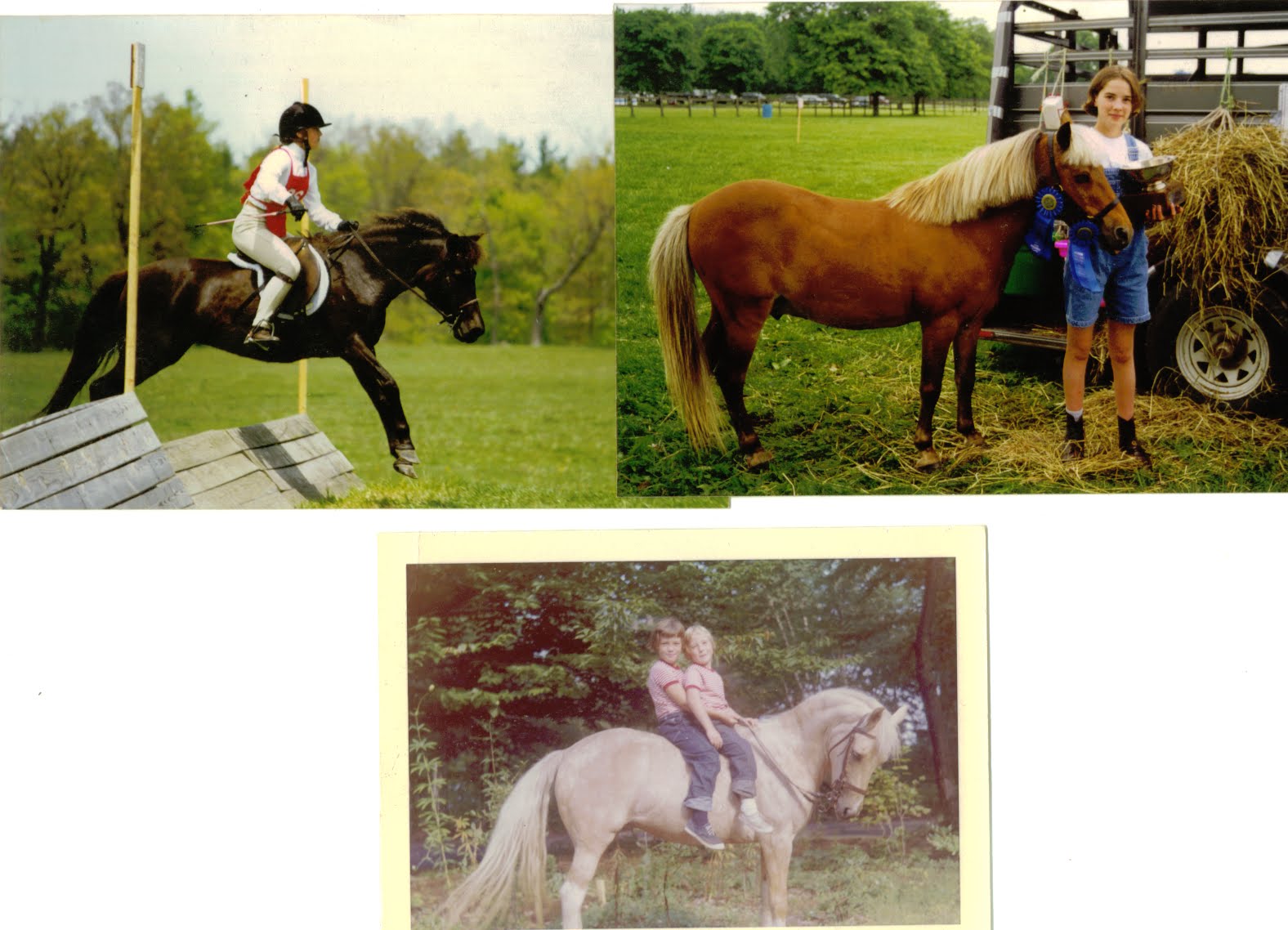
The Children's Pony


The Children’s Pony

When I was three, and we were living in Loudonville, New York, our parents bought us a pony. She was a palomino Welsh pony, with a luxurious silver mane and tail. She had a triangular white patch on her near hindquarter. That marking made its way onto Thunder, the primitive horse in my novel, Wind Rider, as a sign that she was somehow genetically different, with a kind streak which allowed her to be tamed. To this day, Przewalsky horses are nearly impossible to train.

Our pony’s name was Primrose when she came to us, and she was quite naughty at first. I remember that my brother David thought up the name Maple Sugar and gradually she came to trust us and grow into her new name. She settled down to following my mother around like a big golden puppy and allowing all sorts of shenanigans like London Bridge under her belly and multiple children on her back. I truly thought I could ride her and embarrassed myself horribly when I told my teacher at Farm School (a magical nursery school) that I didn’t need to be led. You guessed it! The venerable old pony, Mickey Mouse, ran back to the barn with me at a trot! We did have one scare with Maple Sugar when she ran away down Border Road with my sister, Cathy, on her back. Like Mickey Mouse, she was probably thinking about her hay. Daddy was able to flag down a passing car, head her off, and catch her, and Cathy stayed in the saddle.

That summer, and for the next few years that we had her, we brought Maple to our camp on an island in New Hampshire, where my older brother, Ted, then ten or twelve, rode her on the old logging trails. When I later discovered the Billy and Blaze books by C.W. Anderson, I thought of Ted’s adventures riding his pony alone on the island. She learned to roll under the single strand of electric fence wire and visit Mrs. Fenn next door, who would open the kitchen window and hand her a few chocolate Hydrox cookies.

When we moved to Winchester, MA, in 1957, the fall of my fourth birthday, Daddy built a tiny stable for Maple in the back yard under the oak trees. Our grandparents came over to help and it was a big family project. Maple’s stable was a beautiful little building that stood until my parents passed away and the house was sold fifty years later. It had plank siding, a shingled roof, two windows, an overhang which allowed storage of a few bales of hay, and an electric light which worked from a big round, red battery on a little shelf by the door. I recall sitting in her manger on a winter’s day, methodically setting off a roll of caps from my brothers’ cap guns, one by one, by scratching each with a nail. Maple never minded. She just kept on placidly munching her hay and blowing steamy breaths into the cold air. We have a lovely home movie clip of Maple frisking in new snow on Christmas morning in the back yard.

I don’t really know what happened, but as many ponies do, Maple foundered. I remember the vet coming and big white horse pills which were probably the horseman’s common anti-inflammatory known as “bute.” (Butezaldone—hope my spelling is close I can’t seem to find it in Google.) Founder is a painful condition of the laminae of the hooves which causes lameness. Ponies can recover and be ridden again, but I think my mother was frazzled from raising four kids and felt she just couldn’t cope with a pony any more. In any case, Maple was given to Doris Spollett in Hampstead, NH. Doris was a NH representative in the days when few women were in politics. She loved horse and actually had her childhood pony and family carriage horse stuffed in the barn. She was going to breed Maple. We went to visit our pony once, and when all four children cried, Mummy said, never again. I was six.

Every Christmas after that, I asked for a pony. When my own children began begging for one, a fuzzy, round Shetland pony appeared in the goat pen one Christmas morning. His original name was Peanut. It was magical when the girls, then four and seven, chose Chestnut as his new name. Chestnut lived with us for about fifteen years before going to pony heaven. I am still working on a middle grade novel about him. He was always naughty, but we all loved him dearly. Sometimes he would rest his chin on my shoulder. He went to Pony Club Nationals for games twice and when Fern wanted to “be a cave girl for the summer,” was the inspiration behind Wind Rider. Like my golden childhood pony, Maple Sugar, he too was a Children’s Pony.


The Children’s Pony

We have a golden pony
With silver mane and tail
And Daddy built a house for her
With hammer saw and nail

Davy named her Maple Sugar
Teddy fed her hay
He’s big enough to ride alone
They saw a deer one day

Cathy’s toe got stepped on
It bled and made her cry
And Maple nudged her with her nose
As if to ask her why

I like to go and visit
In my snowsuit, boots, and hat
And sit up in her manger
For a cozy winter chat

We play London Bridges
Underneath her tummy
And she thinks chocolate cookies
At the house next door are yummy

We dressed her up as Pegasus
With cardboard wings and ties
And we were mad that day
Because she didn’t win first prize

She follows Mummy like a dog
And I’m not scared at all
With both fists buried in her mane
I know I couldn’t fall

Our cousins and the neighbors
And the dogs all run beside
And each child gets a turn
When we take Maple for a ride

Friday, December 3, 2010

An Ordinary Childhood

I'm still working on that title, but am simmering up a collection of rhymes about my childhood, 1953 through about 1965. We spent summers on a lake in southern New Hampshire. Maybe that's not so ordinary. We were damned lucky. We still are. My kids only had two weeks there each summer, but they are lake kids in their hearts. Our camp had well water piped to the kitchen sink, but my grandparents' camp had only lake water. My two brothers, Dave and Ted, my sister Cathy, and I were expected to fetch well water every few days for Grammy and Baba in gallon glass jugs.

The easiest way to fill them was from the faucet on the side of the pumphouse behind our camp. This was a little squat building of weathered boards nestled among ancient pines and hemlocks, on a path beside a Colonial-era stone wall. In May, pink ladyslippers sprang out of the pine needles like earthbound fairies. Until August, we battled swarms of mosquitos which thrived in the cool, moist air around the pumphouse.

The jugs were heavy. The good ones had a sort of glass tab which allowed one to use several fingers to carry them. The hard ones had only a ring for the index finger. As the littlest child, I was assigned a half-gallon jug with a tab. I remember being quite fond of my jug. As I grew, I could handle a full gallon like my big sister and finally a gallon in each hand like our bigger brothers. Our grandfather wanted us to develop a little muscle, I think, and didn't like to put the jugs in the cupboard or fridge with pine needls or sand on the bottom, so the challenge was not to set a jug down to rest on the five minute walk.

There was a greater challenge though. When a few gallons had been drawn from the tap, the pump would start up with a loud banging which sounded like: a-huntel! a-huntel! a-huntel! My brothers were masters of terror and invented a little old man who lived in the pumphouse. They told Cathy and me that he resented us taking his water and hammered with his hammer to warn us away. If we took too much, he would burst out the door and come after us. I have a pretty clear image in my mind to this day of a wizened little man running after me with a hammer in his upraised had!

The twist to this horrible possibilty was that the boys were bigger and filled their jugs first. Just about the time their jugs were full, the pump would start up. they would run down the path, laughing, chanting: a-huntel! a-huntel! a-huntel! along with the banging pump. Cathy and I were left quaking, sometimes even crying, yet more fearful of our our grandfather's rath if we didn't fetch our share of water. Even seeing our father go into the pumphouse to work on the pump, peering into that damp, cobwebby, half-underground, concrete chamber and seeing for ourselves that there was nobody at home, didn't entirely erase our fear. Until my grandparents finally had a well drilled at their own camp, my heart always thudded harder when the pump started up and The Little old Man in the Pumphouse started banging away with his hammer.

The Little Old Man in the Pumphouse

There’s a little old man in the pumphouse
My brothers both say that it’s true
But sometimes it’s fun to pretend to be scared
That he’ll jump out and run after you
The little old man in the pumphouse
Has skin that’s all mossy and green
And snaggley teeth and little mad eyes
He’s horrid and hairy and mean

A-huntel! a-huntel! a-huntel!
He hammers with might and with main
A-huntel! a-huntel! a-huntel!
Again and again and again
Who would be stealing my water—my icy-cold bubbling brew?
Children who dare
You’d better beware
Or I’ll hunt with my hammer for you!

There’s a little old man in the pumphouse
He pounds and he pounds with his hammer
We have to fetch water for Grammy and Baba
In spite of the clash and the clamor
Teddy and David are bigger
They make us girls fill our jugs last
And the hammer is pounding as loud as our hearts
As laughing they run away fast

Cathy can carry a big gallon jug
Switching hands without stopping to rest
Our brothers are strong, they can each carry two
But I like my half-gallon best
I can’t set it down because Baba will know
If there’s pine needles stuck to the wet
That drips down the glass on the side of my jug
Like icy-cold hot summer sweat

There’s a damp little room in the pumphouse
One time Daddy opened the door
And pulled on the string that turned on the light
I saw steps and the pump—nothing more
But the little old man in the pumphouse
Still hammers with all of his might
And tho’ I’m quite sure that he’s only pretend
He still makes me shiver with fright

A-huntel! a-huntel! a-huntel!
He hammers with might and with main
A-huntel! a-huntel! a-huntel!
Again and again and again
Who would be stealing my water—my icy-cold bubbling brew?
Children who dare
You’d better beware
Or I’ll hunt with my hammer for you!

Saturday, November 13, 2010

Morning pages, Take Two

11-13-10

Morning Pages as Blog

Well, I didn’t get too far with that. Last entry, May 8th. But the good thing about life is that until we close our eyes for the last time, we can always open them again, and try something once more. Do all writers worry that what they write might be ho-hum drivel? The trouble with morning pages as blog is that they tend to be—and it’s okay—messy, vague, wandering, unedited, or in other words pretty embarrassing if published to the web without spending some time slapping them into shape. But at least it’s a start, and at least it’s writing. It seems like far too many days, I don’t actually write.

There are so many other things to do . . . Sorta like the little boy at Whitesville school who when I was talking to his class about writing, stuck his hand up and asked, “Did you ever think of all the things you could have been doing when you were writing?” So what kept me from it yesterday? Girls Scouts, dear friend Marsha who got me involved . . . and horseback riding, which is not a bad thing to do at all on a glorious, warm sunny day in November when I know there will be months ahead with no riding. Well, at least thanks to Sandy, I have discovered the joy of riding bareback in winter. The insane gallops which Katy and I love so much should be reserved for a saddle and good footing.

I did get an odd and an end done yesterday. Finished Jan de Hartog’s The Little Ark about two children who survive a great flood in Holland in 1953. When I picked it up at Kasey and Kevin Cox’s (From My Shelf Books, Wellsboro, PA) Book Festival used book table a few weeks ago I was thinking he was Meindert DeJong who won the Newbery for The Wheel on the School in 1954 (lovely story about children trying to get storks to roost on the roof of their school). De Hertog’s story is written from the perspective of two children, but the details about the horrific flood with bloated bodies of people and animals are so graphic that I kept wondering if it was at all meant to be a children’s book. I think the only other books I’ve read about Holland are Hans Brinker and the Silver Skates (which I now want to read again after reading about it in the essay on classics at the end of Red Badge of Courage which I recently reread as research for my long-simmering Civil War story) and those lovely artbooks about Trolls that came out about 25 years ago. One of my first serious creative writing attempts must have come soon after reading Mary Mapes Dodge. It was a play that took place in Holland. I was in about fourth grade and I’m pretty sure it was about a flood! Oh look, yummy! I have in my hoard of treasured books a 1932 Garden City Publishing edition of Hans Brinker illustrated by N. C. Wyeth and Peter Hurd. Hmmm, who the heck is Peter Hurd? Any relation to Goonight Moon’s Clement Hurd? (Same generation 1904-1984, western artist, b. Carlsbad, NM territory, student on N.C.)

Quick glance at Jan de Hartog (1914-2002) son of a minister, ran away to sea twice, playwrite, novelist, Dutch national treasure, came to America. He clearly needs more investigation! Anyway, the book was exquisite and despite the tough stuff, very funny.

So yesterday, I read, walked, applied to the Empire State Book Festival, prepped for Scout meeting, rode with Carol, put today’s book signing for Moose Power! at the Canacadea Country Store in Alfred up on Facebook, counted $$ from &#@@!* cookie sales, talked to my girls about courage and strength, taught them how to giftwrap a box of cookies (our sales gimmick for our cookie sale at the Independence Grocery Store Sunday 1-3, do come and buy some cookies!), let them groom and ride little old Shady for horse lovers badge, for dinner made crab cakes to go with our garden carrots and Wiz’s fabulous salad and fried green tomatoes, watched John Stewart and Stephen Colbert, relaxed in the hot tub with Wiz and saw four shooting stars--one stunning--and started a new book, Woof, loaned by Ronnie, dog stories, so far delicious. And all the time, a potential rhyme about “The Little Old Man in the Pumphouse” is running through my head. I tried to write it once. Think I can do better, but the troll on my shoulder keeps saying I’m a lousey poet.

So now, with two quick edits, it's 7:40 and there's lots to do today, so I’m going to post this drivel.

Thursday, October 28, 2010

Shameless Self Promotion


Moose Power!
Muskeg Saves the Day
a sweet Christmas Story

2010 Events: Meet the Author and buy a signed copy for someone you love:


Rochester Children's Book Festival, Monroe Community College, Rochester, NY
Saturday, November 6, 10:00 AM - 4:00 PM
www.rochesterchildrensbookfestival.org

Canacadea Country Store, Main Street, Alfred Station, NY
Saturday, November 13, 11:00 AM - 3:00 PM

Holiday Extravaganza, Main Frame Picture Framing, 112 N. Main Street Hornell, NY
Beckhorn Books and Fire Cat Glass Jewelry
Saturday, December 4th, 1:00 - 4:00 PM

Holiday Booksigning, Independence Grocery Store, 458 Main Street, Whitesville, NY
Sunday, December 5th, Noon - 3:00 PM

Reading and signing Moose Power!, Open Mic Night, Wellsville Creative Arts Center, Main Street, Wellsville, NY, Wednesday, December 8, 7:00 - 9:oo PM

Holiday Booksigning @ Barnes and Noble, Pittsford, NY
Saturday, December 11, 1-3 PM

Santa and Storybooks, Fisher's Pharmacy, 138 N. Main Street, Wellsville, NY 14895
Saturday, December 18th Noon - 2:00 PM

Lift Bridge Bookshop, Brockport, NY
Saturday, December 11, 3:30 - 5:30 PM

Saturday, September 18, 2010

As The World Turns

September: A three o'clock drive down Main Street means stopping for the school bus--Lisa's driving a brand-new one this year! A mom and dog wait for a first grader, the dog wagging, bowing, and barking as she takes the big steps down to the sidewalk. Self-consciously pierced, dyed, and duded-up teens walk hand-in-hand.

Birds are on the move. I glance up from my desk mid-afternoon to see an event happening: thousands of starlings flicker through the woods like tattered black sprites. They keep coming for five minutes, but how long before I noticed them, and why are they moving through the trees like that?

The leaves are changing: no brilliant color yet, but the delicate filigree left by the caterpillar invasion of June is faded green and falling in torn fragments to the ground. Goldenrod glows with a seeming inner light and my favorites, the dark purple asters, are coming on. I think of my birthday coming on as well, October second. Fifty-seven rich and wonderful years. A share of difficulty and heartache, but that is what being human and alive is about, and my share has been blessedly small. The past few days have been rainy and cool, but, there are four more days of summer!

Where have I been? Good adventures, wanderings, and visits with loved ones! No internet service! New memories to store and savor in this old head! In July we went to Virginia where I was a presenter at the VA Highlands Festival. I tried out my new "Writer's Medicine Bag" with treatments for all the ailments, physical and mental that authors suffer, from rejectionitis to writer's block. Plus we got to visit with dear old friends and family. Fun!

Then time and space at my beloved Island Pond in southern New Hampshire. It was a mix of solitude and social whirl with family and friends. I wrote a new story, Camp Dog George, in which a puppy learns the ropes of being a good camp dog from the ghost of the late family dog, Old George. We celebrated daughter Fern's engagement to Scott with songs and laughter. I did a presentation for daughter Spring's Audubon Camp. We raced kayaks and canoes for the WBW Memorial Regatta. (The girls and I placed second in our three-woman-powered canoe!) We recreated Mum's terrible recipes for the MLW Memorial Cook-Off. What a walk down our gastronomically distressed memory lane! We climbed mountains. Fred sold two beautiful tables at the Adirondack Rustic Furniture Fair in Blue Mountain Lake and I signed copies of Moose Eggs and Moose Power at the gift shop. We celebrated Mom and Dad Beckhorn's eightieth birthdays with a wonderful Beckhorn gathering in Owego. One dear old friend, Ranger, was lost to cancer and another sweet one, Linda, was saved from it. Year-old puppy, George, learned to swim after a stick thrown in the lake and leap from the ground straight into our arms.

Home again to lonely cats and an overflowing garden. We've gotten some wood stacked in the cellar, more to do. I've cleaned out the freezer in preparation for filling it again and we've frozen twelve quarts of beans and as many of tomatoes, brocolli, and summer squash. The mornings are dark and chilly. But there will be mist burning off the hills and brilliant Indian summer days, pumkins and cider. Here's an old unpublished song lyric of mine that I made up when the girls were little:

Color Time Rhyme

October is the color time
I like to sing a little rhyme
Come along and walk with me
I'll tell you what we'll see

The leaves are yellow, brown, and red
White geese are flying overhead
I see an orange pumpkin too
The sky is very blue

The squirrel finding nuts is gray
And purple asters line the way
There's nothing blacker than a crow
Green pines stand in a row