We’ve seen them at other islands in the Caribbean—the ubiquitous island dogs. They’re as colorful and friendly as the people, living their lives alongside humans but mostly in a world apart. There is a different attitude toward dogs in a world where there is no extra money for dog food or veterinary care--where you might think twice before patting a dog. Life is easy for vegetarians in Grenada. Everywhere we saw chickens, goats, donkeys, even cows, feeding happily on the abundant vegetation. But there’s not a lot of food available for carnivores. Many of the dogs we saw were hungry, but otherwise healthy and sassy. They pranced up the middle of the narrow roads as if they owned them. But a few were clearly starving. Many had mange or infections of some sort. It was very hard to see. I kept telling myself, at least I am not seeing starving people.
There is a veterinary college in the town of St. George's. Ten leashed dogs wearing service dog vests boarded the plane for the island of Grenada with us at Kennedy. They curled politely under the seats with no noise or fuss. One did piddle on the floor in the airport, but a three year old child might have done the same. Many of these dogs had been rescued in Grenada and, now healthy and the proud owners of loving and attentive veterinary students, were returning from their first vacation in the United States.
I’m trying to get in touch with someone at the college to learn what is being done for the dogs. We saw few strays in St. George's. At the Grand Etang Park, a prime tourist attraction, I saw three dogs in crates in the back of a pickup who were being taken from the vicinity. I don’t know what was to be done with them. I felt that the hungry strays were being removed from the eyes of tourists. But in the rural areas, we saw many of them.
I began saving leftovers from our meals for the dogs. It was my little canine UNICEF program. When we spied a hungry dog, Fred would slow the jeep, I’d whistle to get its attention, and toss a tidbit.
We saw this one at Windward on Carriacou when looking at a wooden boat under construction. The rope indicates that he belongs to someone and is valued.

These guys trotting up the hill by the Catholic church in Mayreau seemed to epitomize the independent, cheerful personality of most of the island dogs we met. They accompanied us on our walk over the hill to Salt Whistle Bay. Wish I'd been quicker with the camera to catch this image of self-sufficient comraderie.

This one seemed to be near the close of her days, sleeping on the beach at Salt Whistle Bay, Mayreau. Although clearly emaciated, she wasn’t particularly interested in the bread and cheese that I offered her. She did take a small drink from a plastic bag.

This is a very typical island dog look, medium sized, upright ears, short fur, more often than not yellow or light brown. We met him outside a cabin on a hike to the Sulphur Spring near Grenville. I asked the owner his name and was told, “He has no name. I just call him ‘dog.’”

Most of the island dogs were hungry, but otherwise healthy, and quite friendly, though some weren’t. Our newly-met friend, Christina from Germany, was bitten when hiking to a nearby beach. The owner claimed the dog had been vaccinated, but it’s hard to believe that many are. I was a bit anxious snapping this photo as the dog did not seem friendly.

These two fairly healthy characters adorn the steps of a bar outside Grenville.

This is one lucky dog. He is sleek, friendly, wears a collar, and seems to belong to La Sagasse resort. We met him while hiking to a hidden beach described in our guide book. He’d been following a family of British tourists but abandoned them to go back to the secret beach with us. When re returned to La Sagasse, He came along. I think he owns the beach.

This one was a heartbreaker. She was clearly ill and starving. We encountered her while watching some fishermen clean their catch. She seemed invisible to them as she licked the raw guts of the fish from the sand.

If there was one dog that I could have taken home, it would have been this nursing mom. She shyly approached our car at Bathway Beach and wagged her tail when I spoke to her. We had a nice chunk of cheese and some bread to offer. A bigger, male dog, in much better weight, came up and started snatching the bits I tossed to her. I threw small bits to him and then gave her the whole piece of cheese when he was distracted. Can or should her pups live? Should she live? I knew I wasn’t solving anything except a hungry belly for one day.

I’ve started work on a picture book called Island Dog. If I get it published, I intend for it to be on sale at every cruise boat port in the Caribbean. Any proceeds I make will go straight to the dogs—so to speak. Meanwhile, every time I hug my own, well fed, George and Spike, I pretend I am sending a little love to an Island Dog.
There is a veterinary college in the town of St. George's. Ten leashed dogs wearing service dog vests boarded the plane for the island of Grenada with us at Kennedy. They curled politely under the seats with no noise or fuss. One did piddle on the floor in the airport, but a three year old child might have done the same. Many of these dogs had been rescued in Grenada and, now healthy and the proud owners of loving and attentive veterinary students, were returning from their first vacation in the United States.
I’m trying to get in touch with someone at the college to learn what is being done for the dogs. We saw few strays in St. George's. At the Grand Etang Park, a prime tourist attraction, I saw three dogs in crates in the back of a pickup who were being taken from the vicinity. I don’t know what was to be done with them. I felt that the hungry strays were being removed from the eyes of tourists. But in the rural areas, we saw many of them.
I began saving leftovers from our meals for the dogs. It was my little canine UNICEF program. When we spied a hungry dog, Fred would slow the jeep, I’d whistle to get its attention, and toss a tidbit.
We saw this one at Windward on Carriacou when looking at a wooden boat under construction. The rope indicates that he belongs to someone and is valued.

These guys trotting up the hill by the Catholic church in Mayreau seemed to epitomize the independent, cheerful personality of most of the island dogs we met. They accompanied us on our walk over the hill to Salt Whistle Bay. Wish I'd been quicker with the camera to catch this image of self-sufficient comraderie.

This one seemed to be near the close of her days, sleeping on the beach at Salt Whistle Bay, Mayreau. Although clearly emaciated, she wasn’t particularly interested in the bread and cheese that I offered her. She did take a small drink from a plastic bag.

This is a very typical island dog look, medium sized, upright ears, short fur, more often than not yellow or light brown. We met him outside a cabin on a hike to the Sulphur Spring near Grenville. I asked the owner his name and was told, “He has no name. I just call him ‘dog.’”

Most of the island dogs were hungry, but otherwise healthy, and quite friendly, though some weren’t. Our newly-met friend, Christina from Germany, was bitten when hiking to a nearby beach. The owner claimed the dog had been vaccinated, but it’s hard to believe that many are. I was a bit anxious snapping this photo as the dog did not seem friendly.

These two fairly healthy characters adorn the steps of a bar outside Grenville.

This is one lucky dog. He is sleek, friendly, wears a collar, and seems to belong to La Sagasse resort. We met him while hiking to a hidden beach described in our guide book. He’d been following a family of British tourists but abandoned them to go back to the secret beach with us. When re returned to La Sagasse, He came along. I think he owns the beach.

This one was a heartbreaker. She was clearly ill and starving. We encountered her while watching some fishermen clean their catch. She seemed invisible to them as she licked the raw guts of the fish from the sand.
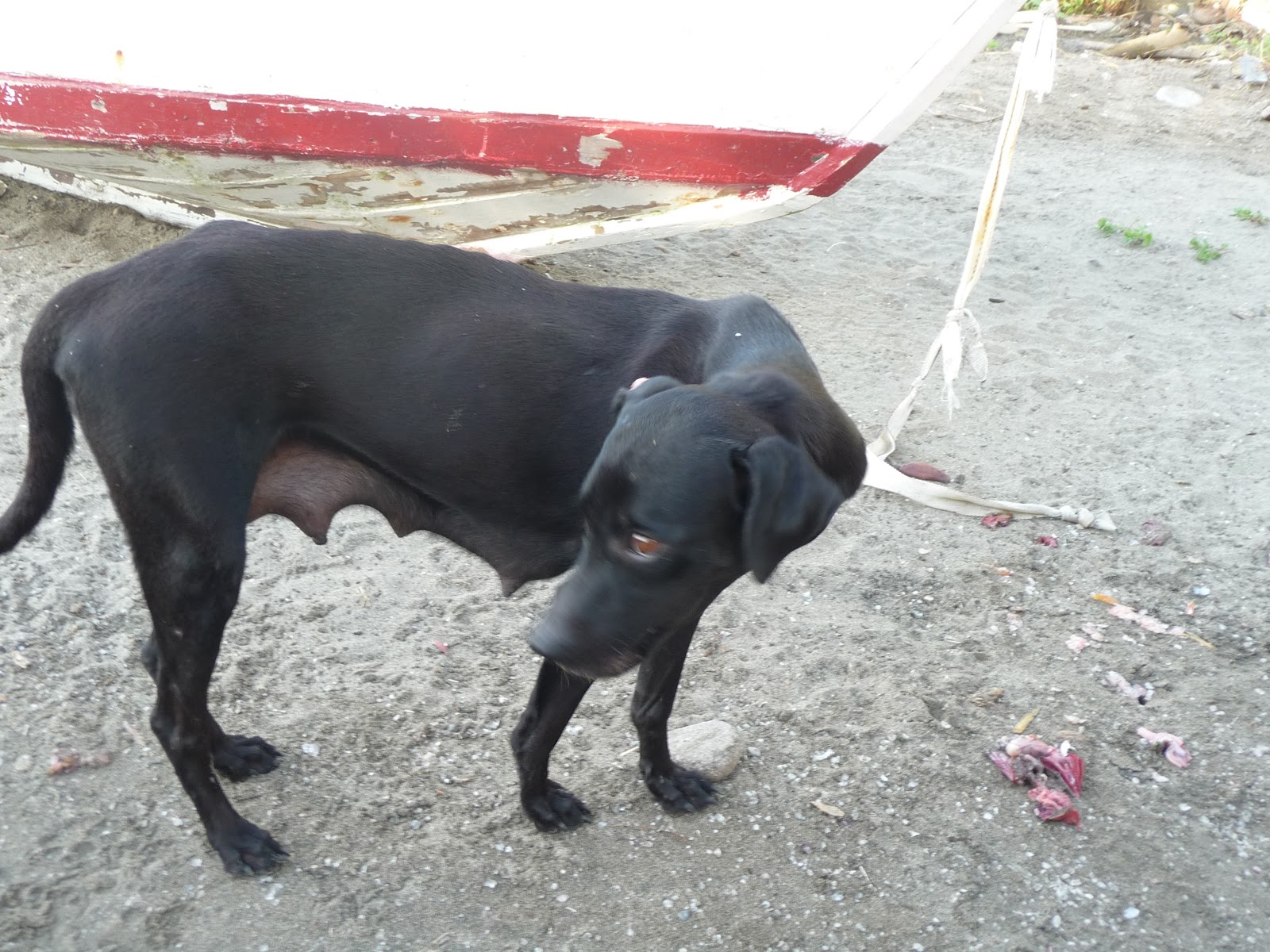
If there was one dog that I could have taken home, it would have been this nursing mom. She shyly approached our car at Bathway Beach and wagged her tail when I spoke to her. We had a nice chunk of cheese and some bread to offer. A bigger, male dog, in much better weight, came up and started snatching the bits I tossed to her. I threw small bits to him and then gave her the whole piece of cheese when he was distracted. Can or should her pups live? Should she live? I knew I wasn’t solving anything except a hungry belly for one day.

I’ve started work on a picture book called Island Dog. If I get it published, I intend for it to be on sale at every cruise boat port in the Caribbean. Any proceeds I make will go straight to the dogs—so to speak. Meanwhile, every time I hug my own, well fed, George and Spike, I pretend I am sending a little love to an Island Dog.

