Tuesday, May 13, 2014

House of a Writers Dreams

I'm glowing with joy. Yesterday I signed a contract with a brilliant agent, Brianne Johnson at Writers House, to represent my new novel, Wolfboy (working title). Writing for kids is a tough business. Not that it's cut-throat--on the contrary, in my line of work, I've encountered some of the kindest, wisest, most honest humans I know. It's just incredibly competitive. Editors are overwhelmed. And they have to be able to sell your quirky, blood-and-tear soaked work of heart. Half the battle is just getting a manuscript read. The other half is writing something worth reading.

Bri can do the rest. She can get my work read, find the right publisher, and help me make the story better if need be. Plus, she's an artist herself--a potter, invites puppies over to play and snooze, reads with a cat on her lap, adores The Clan of the Cave Bear, and passionately loves a good book. What more could I ask?


    When I was little, on hot summer nights, we slept out on the porch of our lakeside summer cottage in New Hampshire. Mum read us an eclectic mix: Thoreau, The Hardy Boys, Charlotte's Web, while we watched the great gray orb weaver trapping mosquitos over our own doorway. Ted and Dave told Cathy and me that the shabby old mounted deer head sometimes winked if you looked carefully. There weren't enough cots, so Cathy and I would each pull two of the rattan armchairs with the squeaky turquoise cushions together and make ourselves cozy "boat-beds." From the swamp across the lake, came the booming of bullfrogs and the rhythmic chanting of whip-poor-wills. The air was fishy and piney, laden with the perfume of the sweet pepper bushes that line the shore. Once in a while, as we were dropping off to sleep, a Luna moth would flutter fairy-like to the screen and settle between the fireflies for an ethereal visit. In seventh grade I wrote a story called, Annie's Fairy, which later became The Kingfisher's Gift, published by Philomel Books in 2002 and awarded a Junior Library Guild Honor.

This was meant to be a caption for this photo illustrating the glow I am feeling today. Sorry, I couldn't stop!

Thursday, May 8, 2014

Cave of a Writer's dreams

This is one of the few images I have from our trip to France a year ago, as our camera was stolen in Marseilles, but it's a favorite. I had happened to post a few shots on Facebook and was able to retrieve them. Fred and I visited Pont Vallon d'Arc in the Ardeche River gorge where the incredible Grotte Chauvet was discovered in 1994. The cave is filled with stunning paintings that may be the oldest art in the world, and which rival anything painted anywhere since. Who knew that wooly rhinos once roamed the area? But there they are on the walls, almost snorting and twitching their ratty tails, along with horses, bison, bears, lions, and many other creatures from thirty thousand years ago--but curiously these people seldom or never depicted humans or dogs.

For the past year, I'd been reading everything I could get my hands on about dogs, from old kids' books to Mark Derr's How the Dog Became the Dog, in preparation for writing my novel, Wolfboy (working title). In the cavern, they found the footprint of a boy and a canine, apparently walking side by side. Wolf? Dog? Chills up my spine! Wolf tracking boy? Early dog and boy walking together as friends the same day--or unrelated footprints ten thousand years apart? There are also depressions in the cave floor left by hibernating cave bears, along with the bones of many of those bears. Oh the rich material for imagination!

Chauvet was never opened to the public for fear of the molds which have damaged Lascaux. Fred and I knew we would not be able to enter the cave, but I had read books, studied photographs, and watched the documentary, Cave of Forgotten Dreams, several times. I had come here to see the area and try to absorb the aura of this sacred place. We hiked up the winding trail under soaring cliffs to the entrance which was sealed off like some sort of James Bond stronghold. Conscious of the surveillance cameras trained on us, we peered through the barred gate into the area where researchers don protective clothing before entering. Then we scuttled along the steep, wooded slope a few yards further and found this little hollow in the rock. It was big enough for a person to shelter. Perhaps someone long ago spent a rainy night there.  

Thursday, January 2, 2014

It's the second day of 2014. 7:35. Eight degrees out, a little snow falling. I'm still cuddled in bed with a cup of good coffee and my little dog, George, curled up between my feet. At nine o'clock, Wiz and I plan to cross-country ski with our friend Marsha Van Vlack and her daughter, Marian. But for now, I can get in some writing time when my brain is closest to the dreamworld. My morning routine makes the frustration of flying days filled with necessary tasks and distractions that suck away my work time a little calmer. And it's delicious.

My new MG novel, Wolfboy, is just starting going out to agents. I am filled with hope. It's a good story, and one that hasn't been told much, I think--how the first dog might have been brought home to become part of a human family. I've only found a few other authors who have done it, and mostly they have the wolf just a side character, or are writing for younger audiences.

As I look at the coming months, I need to get some of my unsold work out there. Submit! (How I hate that word!) But I also need to start a new project. I think there is more to Kai and Uff's story, I'm hoping a trilogy. Plotting is very hard for me. I'm trying to look at it from the angle of what would I as a kid like to read? Writing in prehistory has its challenges, to say the least. But I love my characters and I know that more happens to them. Once I get engaged and know where I'm going, it's addictive. But the in-between time it always very difficult.

I can hear my husband clanking around the kitchen, filling the plastic water bucket for the chickens, getting ready to do the morning feeding of birds and horses. Time to go be part of the day, with part of my mind open to inspiration.
    

Wednesday, April 18, 2012

A Big Day Birding


Sunday afternoon, April 18, Fred and I drove first to Brubaker’s pond at the top of the hill west of Whitesville on Rt. 248, where I had been seeing three swans hanging out with a snow goose and a gang of Canadas for the last few days. They first time I’d spotted the huge white birds with my slightly aged eyes, I’d thought perhaps they were sheep. Then I’d opened the new issue of the Conservationist that morning to read that the state had released Trumpeter swans at Montezuma refuge in 2011 and I had to have a closer look. The Trumpeters were supposed to have highly visible green tags on the wings and have legs bands as well. I consulted my Sibley’s Guide carefully on the slight differences between Tundra and Trumpeter swans (Trumpeters have more evenly rounded backs, a longer, straighter bill with never any yellow on lores, and the yearlings tend to be grayer). There they were—still contentedly grazing. Fred stayed back while I moved as close as I could, pausing to study them through my binoculars, until they finally got uneasy and lifted up to circle the fields. The snow goose was the leader and it was stunning to watch the four big birds flying low, the hazy late afternoon sun illuminating their white feathers. We saw no green tags on the swans, though their bills were very black and their necks quite gray. In any case, I haven’t seen many Tundras and it was the best view of a snow goose I’ve had.


Next, we went to Brown’s marsh and were treated to a loon, a small flock of female hooded mergansers, a lesser scaup (?), a kingfisher, and a handsome great egret fresh from the sunny south. Another big, white bird! In the ditches I saw many painted turtles and frogs peering out of the muck, and in the shallows near the parking lot a huge snapping turtle was hanging out sideways, its shell looking like a discarded tire. Fred was sure it was dead, but I saw the head come up once and a foot thrash a couple of times. (The next day it was still there and I thought I could see another shell of similar size under it—a lengthy interlude of springtime snapping turtle bliss?)


Even without driving down towards Genesee to see the new eagles’ nest again, it had been a good outing. Then coming home over the hill from Independence, we spotted a big bird in the middle of the road. A very large, brown bird. An eagle? A turkey? AN ENORMOUS BIRD! What the . . .?


Suddenly we realized it was the escaped emu which has been wandering the country side this spring. It wasn’t very shy. In fact, it allowed us to slowly draw abreast of it, much to the consternation of our little Jack Russell, Georgie. I could have tossed her out the window onto the giant bird’s back, but I held tight—I’m told they pack a powerful kick! It was fascinating to watch the huge, leathery feet as they flattened and contracted with each step, the vast, meaty (and delicious, I’m told) thighs and drumsticks working as it paced slowly along, the heavy, shifting mass of grayish feathers rustling on its back, and its enormous, brown dinosaur-like eyes with their incongruous fringe of eyelashes—wary and reptilian, staring back at us. Dye it yellow, give it a sweeter disposition, and it could have been a visitor from Sesame Street.


A very big bird day indeed!

Monday, March 26, 2012

An Impromptu School Visit in Grenada


When Fred and I travel, I like to bring books along as gifts for local libraries and schools. In Grenada, we stopped at the Catholic school in the village of Sauteurs one morning. The school is located high on a bluff overlooking the crashing waves of the Atlanic Ocean. Nearby, the Leapers Hill Monument memorializes a group of Carib Indians who, back in the seventeen hundreds, leapt to their deaths off the cliff rather than be captured by the French. (Sauteurs means “leapers.”) A few days earlier, we had met two delightful little students at the monument when we were sightseeing and had promised to visit their school while they both tried to look through my binoculars at once.


I was greeted cordially by the headmaster, who immediately recognizing an educational opportunity, expressed his regret that I hadn’t given them some notice that an author was in town. He was right. I need to get over my some-times-still-shy self and realize that after a lifetime of books and words, I actually to have some useful things to say. Next time I will try to plan ahead. I recalled the time there was a mix-up about which presentation I was to do at the Rochester Children’s Book Festival and I managed to pull off my “Writer’s Toolbox” without the actual toolbox. My little red toolbox is full of silly concrete items which illustrate the basics of good writing. But I got my points across by drawing each item on the board as I spoke. “Well . . .” I responded, “I could talk to a class or two right now . . .”


So next thing I knew, the startled teacher had graciously stepped aside, and I was addressing the first of two groups of ten or eleven year old children. First, I drew a rough map of New York State on the black board, showing how the Genesee River flows north and where I live near its source, our own beautiful Adirondack Mountains in the northeast, New York City in the southeast, and explained that I live in the woods very far away from the city. Then I described each of my books, which they would now find in their library. I had brought along two new red plastic water bottles, complimentary gifts from Island Windjammers and the Diamant on which Fred and I had sailed the previous week. Again, the headmaster showed himself to be quick in seizing educational opportunities for his kids, and asked that I award them as prizes for one child in each group who proved to be a good listener and could answer a question posed by me at the end of my talk.


I drew deer and moose for them, my house, and my little dog George. I condensed my tool box to three main concepts. I talked about the troll who creeps up on our shoulders and whispers that our work is dreadful and should be torn-up and tossed in the trash. Does that troll (inner censor) help us to write? No, of course not! So in he goes to our troll jar—one of a writer’s most necessary tools. Next I drew them a big caterpillar reading a book and we talked about how my pet book worm teaches me the importance of reading for good writing. Just as we cannot exhale without first inhaling, we cannot expect to be able to write without first reading—the more the better! Lastly, I talked about my magic earphones and the importance of reading aloud with a critique partner when revising one’s work.

Awarding the water bottles proved very difficult. They had all hung on my words so carefully that I had to ask several questions, “Which way does the Genesee River flow? What is my little dog’s name? How is a moose different from a deer?” In the end I chose the quickest children. When I asked one little boy his name, I had to smile at his answer. Despite his clearly African, possibly Carib, ancestry, he answered, “Angus.” Did he have a drop or two of wild clansman in him as well? There was an influx of Scottish shipbuilders to Grenada in the past. Here was a bit of history preserved in a name. A third time, the headmaster impressed me by reviewing my three points flawlessly for the kids. I sure wished I’d had a water bottle for him and fifty more for the kids!

Tuesday, February 14, 2012

Walking to School in Grenada


Everywhere we went in Grenada, we saw children walking to and from school. They were usually in laughing, high spirited groups. Most wore uniforms. Perhaps some walk to bus stops, but it seemed to me that many of them have quite long walks up and down the very hilly terrain along the narrow, winding roads. We saw moms, dads, and big brothers and sisters leading beautifully dressed toddlers to and from pre-school. What a big time commitment! Education is obviously important.


After a day or two, when we realized how friendly people were, we began offering rides to folks. Many people carry the universal tool-of-all-trades, the machete, commonly called a “cutlass.” Our American sensibilities kept us from inviting people wielding potential weapons to ride with us. We also didn’t feel right offering rides to children, but adults seemed happy to get a lift. It was fun chatting. One young man, living in a remote part of the island, told me he is studying mechanical engineering at a community college. Another wants to be a teacher and asked for my address. I hope I hear from him.


Kids in the states don’t walk much any more, but I was reminded of my own walks to Lincoln and Mystic Schools in Winchester, MA, in the 1960’s. We walked 9/10th of a mile four times a day, in good weather coming home for lunch, totaling about 3 1/5 miles. In winter we brought our lunch, but walked despite the snow and ice. It was also hilly terrain. Luckily it was downhill on the way to school or we would have often been tardy. My sister, Cathy, and I sometimes ran all the way, pretending we were horses. The uphill slog home, lugging books, our clarinets, school projects, etc. could be tiresome. Nobody used backpacks then, so our arms got pretty tired. But on the whole, it was often the best part of the day. Bookworm that I was, I even mastered the art of reading as I walked along the sidewalk, stopping when my peripheral vision noted curbs and intersections. Monday mornings, I brought home bouquets salvaged from the bin behind St. Mary’s Church. In the fall there were fists full of bright leaves. How we loved to kick our feet crisply through them. In the spring I picked masses of lily–of-the-valley, lilacs, and apple blossoms by the old quarry behind the Harwood’s house. When I changed to Mystic School in sixth grade, it was magical walking the brick path next to the Freeman’s greenhouse and pond, exactly like Mr. McGregor’s garden.


I imagine the school children in Grenada, picking fruit and flowers, seeing birds and iguanas, perhaps a mongoose scuttling into the underbrush, passing tethered goats, flocks of foraging hens with puffball chicks, stray dogs, and chatting with neighbors as they pass. There are fishing boats out on the water to watch, perhaps an ancient cannon to visit, careening buses and jeeps to stay clear of. The ubiquitous American school bus has robbed kids in the USA of such good things.

Monday, February 6, 2012

Island Dogs of Grenada

We’ve seen them at other islands in the Caribbean—the ubiquitous island dogs. They’re as colorful and friendly as the people, living their lives alongside humans but mostly in a world apart. There is a different attitude toward dogs in a world where there is no extra money for dog food or veterinary care--where you might think twice before patting a dog. Life is easy for vegetarians in Grenada. Everywhere we saw chickens, goats, donkeys, even cows, feeding happily on the abundant vegetation. But there’s not a lot of food available for carnivores. Many of the dogs we saw were hungry, but otherwise healthy and sassy. They pranced up the middle of the narrow roads as if they owned them. But a few were clearly starving. Many had mange or infections of some sort. It was very hard to see. I kept telling myself, at least I am not seeing starving people.

There is a veterinary college in the town of St. George's. Ten leashed dogs wearing service dog vests boarded the plane for the island of Grenada with us at Kennedy. They curled politely under the seats with no noise or fuss. One did piddle on the floor in the airport, but a three year old child might have done the same. Many of these dogs had been rescued in Grenada and, now healthy and the proud owners of loving and attentive veterinary students, were returning from their first vacation in the United States.

I’m trying to get in touch with someone at the college to learn what is being done for the dogs. We saw few strays in St. George's. At the Grand Etang Park, a prime tourist attraction, I saw three dogs in crates in the back of a pickup who were being taken from the vicinity. I don’t know what was to be done with them. I felt that the hungry strays were being removed from the eyes of tourists. But in the rural areas, we saw many of them.

I began saving leftovers from our meals for the dogs. It was my little canine UNICEF program. When we spied a hungry dog, Fred would slow the jeep, I’d whistle to get its attention, and toss a tidbit.

We saw this one at Windward on Carriacou when looking at a wooden boat under construction. The rope indicates that he belongs to someone and is valued.


These guys trotting up the hill by the Catholic church in Mayreau seemed to epitomize the independent, cheerful personality of most of the island dogs we met. They accompanied us on our walk over the hill to Salt Whistle Bay. Wish I'd been quicker with the camera to catch this image of self-sufficient comraderie.


This one seemed to be near the close of her days, sleeping on the beach at Salt Whistle Bay, Mayreau. Although clearly emaciated, she wasn’t particularly interested in the bread and cheese that I offered her. She did take a small drink from a plastic bag.


This is a very typical island dog look, medium sized, upright ears, short fur, more often than not yellow or light brown. We met him outside a cabin on a hike to the Sulphur Spring near Grenville. I asked the owner his name and was told, “He has no name. I just call him ‘dog.’”


Most of the island dogs were hungry, but otherwise healthy, and quite friendly, though some weren’t. Our newly-met friend, Christina from Germany, was bitten when hiking to a nearby beach. The owner claimed the dog had been vaccinated, but it’s hard to believe that many are. I was a bit anxious snapping this photo as the dog did not seem friendly.


These two fairly healthy characters adorn the steps of a bar outside Grenville.


This is one lucky dog. He is sleek, friendly, wears a collar, and seems to belong to La Sagasse resort. We met him while hiking to a hidden beach described in our guide book. He’d been following a family of British tourists but abandoned them to go back to the secret beach with us. When re returned to La Sagasse, He came along. I think he owns the beach.


This one was a heartbreaker. She was clearly ill and starving. We encountered her while watching some fishermen clean their catch. She seemed invisible to them as she licked the raw guts of the fish from the sand.


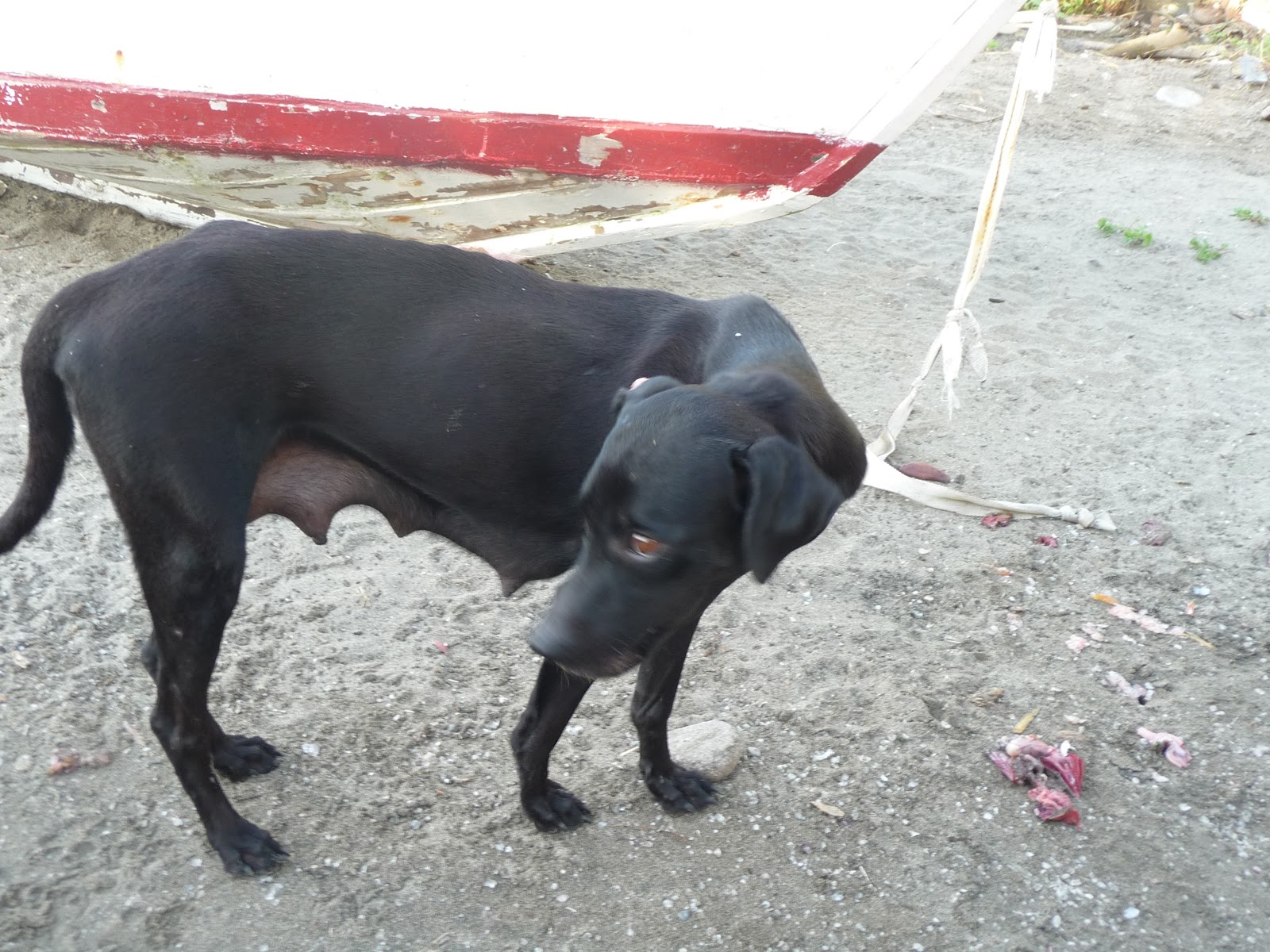
If there was one dog that I could have taken home, it would have been this nursing mom. She shyly approached our car at Bathway Beach and wagged her tail when I spoke to her. We had a nice chunk of cheese and some bread to offer. A bigger, male dog, in much better weight, came up and started snatching the bits I tossed to her. I threw small bits to him and then gave her the whole piece of cheese when he was distracted. Can or should her pups live? Should she live? I knew I wasn’t solving anything except a hungry belly for one day.


I’ve started work on a picture book called Island Dog. If I get it published, I intend for it to be on sale at every cruise boat port in the Caribbean. Any proceeds I make will go straight to the dogs—so to speak. Meanwhile, every time I hug my own, well fed, George and Spike, I pretend I am sending a little love to an Island Dog.