Tuesday, February 14, 2012

Walking to School in Grenada


Everywhere we went in Grenada, we saw children walking to and from school. They were usually in laughing, high spirited groups. Most wore uniforms. Perhaps some walk to bus stops, but it seemed to me that many of them have quite long walks up and down the very hilly terrain along the narrow, winding roads. We saw moms, dads, and big brothers and sisters leading beautifully dressed toddlers to and from pre-school. What a big time commitment! Education is obviously important.


After a day or two, when we realized how friendly people were, we began offering rides to folks. Many people carry the universal tool-of-all-trades, the machete, commonly called a “cutlass.” Our American sensibilities kept us from inviting people wielding potential weapons to ride with us. We also didn’t feel right offering rides to children, but adults seemed happy to get a lift. It was fun chatting. One young man, living in a remote part of the island, told me he is studying mechanical engineering at a community college. Another wants to be a teacher and asked for my address. I hope I hear from him.


Kids in the states don’t walk much any more, but I was reminded of my own walks to Lincoln and Mystic Schools in Winchester, MA, in the 1960’s. We walked 9/10th of a mile four times a day, in good weather coming home for lunch, totaling about 3 1/5 miles. In winter we brought our lunch, but walked despite the snow and ice. It was also hilly terrain. Luckily it was downhill on the way to school or we would have often been tardy. My sister, Cathy, and I sometimes ran all the way, pretending we were horses. The uphill slog home, lugging books, our clarinets, school projects, etc. could be tiresome. Nobody used backpacks then, so our arms got pretty tired. But on the whole, it was often the best part of the day. Bookworm that I was, I even mastered the art of reading as I walked along the sidewalk, stopping when my peripheral vision noted curbs and intersections. Monday mornings, I brought home bouquets salvaged from the bin behind St. Mary’s Church. In the fall there were fists full of bright leaves. How we loved to kick our feet crisply through them. In the spring I picked masses of lily–of-the-valley, lilacs, and apple blossoms by the old quarry behind the Harwood’s house. When I changed to Mystic School in sixth grade, it was magical walking the brick path next to the Freeman’s greenhouse and pond, exactly like Mr. McGregor’s garden.


I imagine the school children in Grenada, picking fruit and flowers, seeing birds and iguanas, perhaps a mongoose scuttling into the underbrush, passing tethered goats, flocks of foraging hens with puffball chicks, stray dogs, and chatting with neighbors as they pass. There are fishing boats out on the water to watch, perhaps an ancient cannon to visit, careening buses and jeeps to stay clear of. The ubiquitous American school bus has robbed kids in the USA of such good things.

Monday, February 6, 2012

Island Dogs of Grenada

We’ve seen them at other islands in the Caribbean—the ubiquitous island dogs. They’re as colorful and friendly as the people, living their lives alongside humans but mostly in a world apart. There is a different attitude toward dogs in a world where there is no extra money for dog food or veterinary care--where you might think twice before patting a dog. Life is easy for vegetarians in Grenada. Everywhere we saw chickens, goats, donkeys, even cows, feeding happily on the abundant vegetation. But there’s not a lot of food available for carnivores. Many of the dogs we saw were hungry, but otherwise healthy and sassy. They pranced up the middle of the narrow roads as if they owned them. But a few were clearly starving. Many had mange or infections of some sort. It was very hard to see. I kept telling myself, at least I am not seeing starving people.

There is a veterinary college in the town of St. George's. Ten leashed dogs wearing service dog vests boarded the plane for the island of Grenada with us at Kennedy. They curled politely under the seats with no noise or fuss. One did piddle on the floor in the airport, but a three year old child might have done the same. Many of these dogs had been rescued in Grenada and, now healthy and the proud owners of loving and attentive veterinary students, were returning from their first vacation in the United States.

I’m trying to get in touch with someone at the college to learn what is being done for the dogs. We saw few strays in St. George's. At the Grand Etang Park, a prime tourist attraction, I saw three dogs in crates in the back of a pickup who were being taken from the vicinity. I don’t know what was to be done with them. I felt that the hungry strays were being removed from the eyes of tourists. But in the rural areas, we saw many of them.

I began saving leftovers from our meals for the dogs. It was my little canine UNICEF program. When we spied a hungry dog, Fred would slow the jeep, I’d whistle to get its attention, and toss a tidbit.

We saw this one at Windward on Carriacou when looking at a wooden boat under construction. The rope indicates that he belongs to someone and is valued.


These guys trotting up the hill by the Catholic church in Mayreau seemed to epitomize the independent, cheerful personality of most of the island dogs we met. They accompanied us on our walk over the hill to Salt Whistle Bay. Wish I'd been quicker with the camera to catch this image of self-sufficient comraderie.


This one seemed to be near the close of her days, sleeping on the beach at Salt Whistle Bay, Mayreau. Although clearly emaciated, she wasn’t particularly interested in the bread and cheese that I offered her. She did take a small drink from a plastic bag.


This is a very typical island dog look, medium sized, upright ears, short fur, more often than not yellow or light brown. We met him outside a cabin on a hike to the Sulphur Spring near Grenville. I asked the owner his name and was told, “He has no name. I just call him ‘dog.’”


Most of the island dogs were hungry, but otherwise healthy, and quite friendly, though some weren’t. Our newly-met friend, Christina from Germany, was bitten when hiking to a nearby beach. The owner claimed the dog had been vaccinated, but it’s hard to believe that many are. I was a bit anxious snapping this photo as the dog did not seem friendly.


These two fairly healthy characters adorn the steps of a bar outside Grenville.


This is one lucky dog. He is sleek, friendly, wears a collar, and seems to belong to La Sagasse resort. We met him while hiking to a hidden beach described in our guide book. He’d been following a family of British tourists but abandoned them to go back to the secret beach with us. When re returned to La Sagasse, He came along. I think he owns the beach.


This one was a heartbreaker. She was clearly ill and starving. We encountered her while watching some fishermen clean their catch. She seemed invisible to them as she licked the raw guts of the fish from the sand.


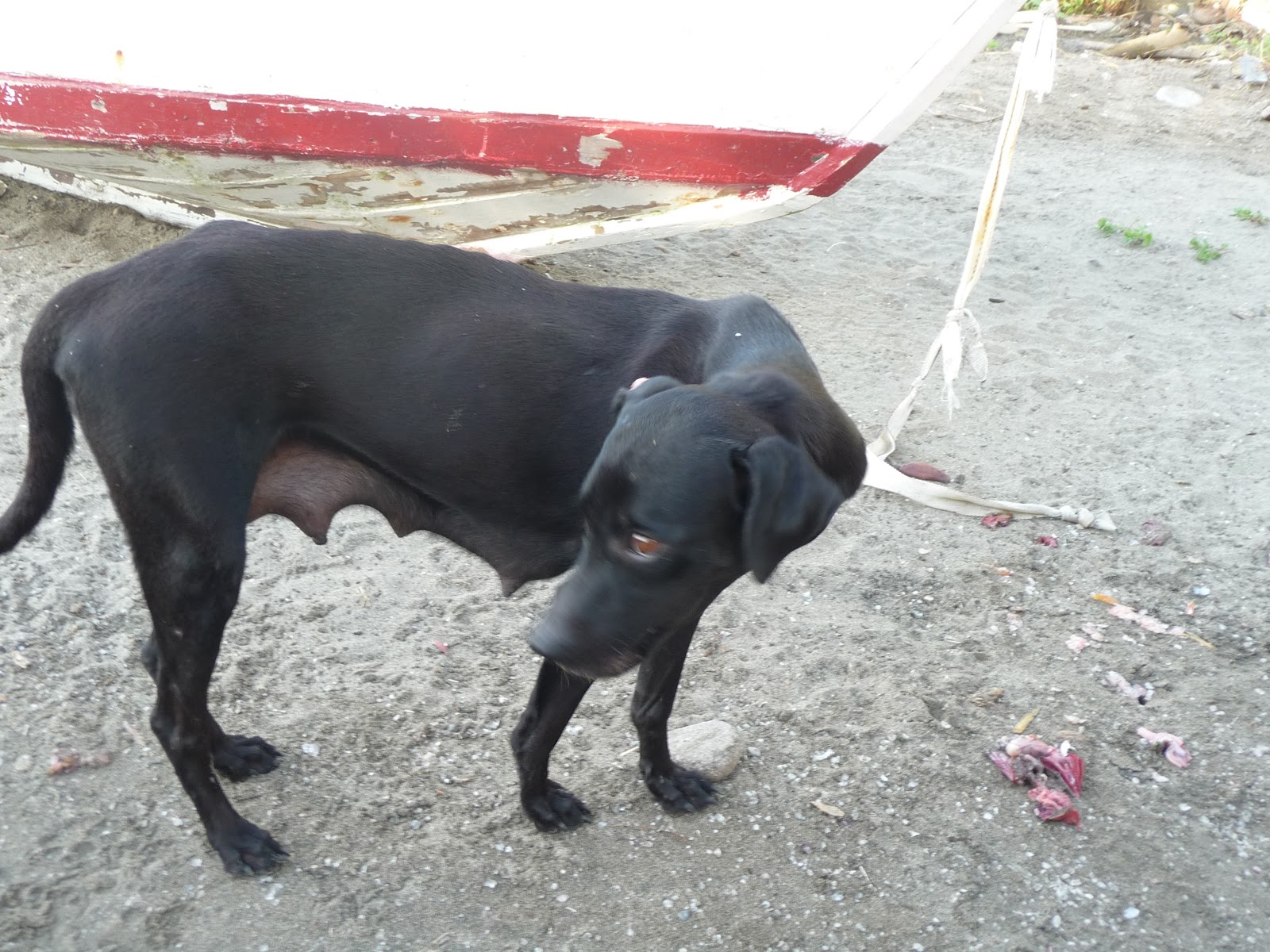
If there was one dog that I could have taken home, it would have been this nursing mom. She shyly approached our car at Bathway Beach and wagged her tail when I spoke to her. We had a nice chunk of cheese and some bread to offer. A bigger, male dog, in much better weight, came up and started snatching the bits I tossed to her. I threw small bits to him and then gave her the whole piece of cheese when he was distracted. Can or should her pups live? Should she live? I knew I wasn’t solving anything except a hungry belly for one day.


I’ve started work on a picture book called Island Dog. If I get it published, I intend for it to be on sale at every cruise boat port in the Caribbean. Any proceeds I make will go straight to the dogs—so to speak. Meanwhile, every time I hug my own, well fed, George and Spike, I pretend I am sending a little love to an Island Dog.


Sunday, January 8, 2012

Getting Ready for Grenada

In just a few days, Fred and I are off for an overdue thirtieth wedding anniversary trip to the island of Grenada in the Caribbean. We'll spend a week sailing and a week at a cottage on the north end of the island. We've been reading up and taking extra long walks to get ready for hiking in the mountains there. The island got hit very hard by hurricanes a few years ago, so we are hoping the trails are open now. I'm looking into Project Stuff Your Rucksack to find out about some small items we could bring with us that might be needed by a school. Of course I'll be bringing some books. I'm really hoping to see a mona monkey and a Grenada dove--and lots of other birds. Santa brought me Birds of the West Indies for Christmas! And we plan to do lots of snorkeling! Here's a favorite shot of us resting after a hike at Carter Notch in the White Mountains of New Hampshire. We probably won't need the polar fleece for Grenada! 


Thursday, January 5, 2012

Christmas Bird Count on Toad Hill

I wasn’t going to do it. Ronnie had asked me to go on a Christmas count with her and I’d declined. I’d neglected my work so badly over the holidays. It’s frightening how much time I spend on Christmas. It’s a sort of love/hate vortex that I just can’t stop myself from being sucked into. The New Year is fresh energy. Days lengthening. Creative juices flowing.


It was only to be a short walk for some exercise. Fred had twisted his back, so it was just little dog, George, and me. January second. Windy flurries and patches of sun. A thin snow cover. I headed out back along the trail that skirts the brow of the hill behind the house.


There was a twitter and flurry of two tiny birds doing acrobatics on the ends of some maple twigs. Not chickadees. I was suddenly alert. But I’d never see them with these fuzzy 58 year old eyes. Ah, but they came closer! Curious. Friendly. The eye stripes and bright yellow Mohawks were unmistakable. Golden Crowned Kinglets!


Okay. This must be a message. No husband to get impatient. My work can wait an hour or so longer. The Murphy’s law of binoculars is that if you don’t bring them along, you will wish you had. I raced back to the house for my brand new ones that Nikon so kindly sent to replace my old pair with the faulty eye rings.


The kinglets had moved on. But maybe I could scare up some grouse. I had read that their numbers are declining, but I think we still have a healthy population on Toad Hill. It would be good to report some. We walked behind the old Scotch pine plantation that the loggers ripped out last fall and fed to the chipper. They were planted for Christmas trees in the fifties, let go, and now are slowly dying off. These bare patches look like war zones right now, but the native trees will come back and create a healthier forest.


George scouted the edge of some brush piles, and pouff! A grouse zoomed out and veered into the woods like a low flying fighter plane. “Get ‘em George!” I called, but she is clearly not a bird dog. Tail waging, she snuffled her muzzle into a tuft of snowy grass. Mice are more her style. I stomped among the brush piles. Pouff! Pouff! Pouff! Out rocketed three more grouse.


We crossed the road onto the old Kane farm. With the Scotch pines gone, it’s easier to imagine a dairy farm and pastures here. Last fall a pair of blue birds hung around for some time. It will be interesting to see how the birds like all this clear cutting. The rough foundation of a tiny school house can be found on the Lyons Road. I can picture ten or so kids from these several hilltop farms gathering here for lessons. Before those families, this was wilderness. Such a short history of Caucasian influx.


I tramp up through the old orchard which Fred is reviving with six new trees and judicious pruning of the gnarled and lonely survivor—a tasty Snow apple. A red tailed hawk lifts out of the spruces. These also were planted, but they are healthier, so we are leaving them. The hawk is so huge that I am transfixed, waiting for the turn and flash of the bight rusty tail. I feel a surge of joy. Winter is far from dead and dull!


I have hardly lowered my glasses when there is a wild and rowdy barking overhead. A flock of Canada geese, perhaps ninety strong, are heading south. Now? Well, there’s been barely any snow, and winter is still very young.


At the edge of Jerry Smith’s field, I step out into the open beside a round bale to take in the view and gaze at the blustery sky. Patches of blue, but the Whitesville valley is socked in with steel gray. I duck back across the hedgerow. Maybe I can spot some turkeys behind Book’s cabin. I am cruising down the trail that borders our south boundary when I look off to my left. What the heck bird is that? It’s huge and long. Bluish gray. For an instant I think great blue heron, but it’s too late for one. The bird cruises closer over the hayfield, wheels, and suddenly the underside is exposed, starkly black and white. Gorgeous. A rough leg? It’s too early for them to have come down from the north isn’t it? I watch until it is out of sight.


No turkeys. Oh well. It’s been pretty satisfying. Back at the house I check with Sibley and decide that the gorgeous bird was a male harrier. The feeder is as busy and competitive as Black Friday at the mall. Everyone is stocking up for a drop in temperature and a bit of weather. I make sure the cats are in. I'm trying to only tlet them out at night these days. George happily sheds her polar fleece coat and heads for the couch. My cheeks are pink and tingling. Now it’s time to hit my desk.

Tuesday, December 27, 2011

Tree Trimming 2011 (It sounds like a college course.)


In the 1950’s a former owner of our property planted many acres to Scotch pine and spruces for Christmas trees. When we came to Irish Hill Road in 1980, the blocks of Scotch pines had become impenetrable jungles, perfect hideouts for deer. Gradually, porcupines and disease were killing them off. The spruces fared better, growing into handsome stands where crows and blue jays love to nest. All over the property seedlings from those plantings have sprung up.


Fred and I both come from traditions of wild Christmas trees. My family cut willowy hemlocks at our camp in New Hampshire. The Beckhorns cut bushy little white pines from Grampa Gach’s farm in Alfred. In our youth we both worked at Stutzman’s Christmas tree farm in Hornell and we well know how a nicely pruned Christmas tree should look, but we’ve always been happy with our “Dr. Seuss “ trees, as Fred sometimes calls the more unruly ones. Sometimes we have cut a big tree and lopped off the top. Most years we locate a suitable one growing on our property right alongside Irish Hill Road.


This year we found our tree right across from Fred’s shop. We’d passed it many times with a thought towards the holidays, but the little spruce’s double trunk always nixed it. How could we ever get it into the stand? The young evergreens that spring up in the ditch along the south side of the road shade it and ice remains here long after it has melted other places. They need to come out anyway. Well, let’s just take a look. . . Lo and behold, the double trunk had split from a single stem eight inches from the ground—just enough to fit into the stand. It was perfect. Once set up in the front room, there was no room to actually put a gift under the tree, but no matter.


With the kids grown, decorating is my business. Football is Fred’s. But this year I made a bargain—you put on the lights and I’ll handle the ornaments. It worked. He dutifully tackled the job—but of course I found myself helping to untangle strings, tightening bulbs, and replacing duds. It was fun doing it together. Now I was in the mood. Fred retired to the couch and the game and I, blind and mostly deaf to the NFL or whatever FL was running roaringly around on the screen—set to work.


My husband is an apple tree pruner, a fire wood cutter, a wood butcher, and furniture builder, but he is not a tree decorator. Well, what self respecting woman would trust a man to trim a tree anyway? I ask myself. There’s an art to it. You can’t hang six ornaments on one branch, fragile ones within cat reach, or the best ones at the back—as my man has been known to do—and he may be a wood artist, but you don’t want to set him loose with a box of tinsel.


Now if you’re going to decorate something, a tree is a damn good choice. There are all those branches! Every year I tell myself, you don’t have to put all the ornaments on, but every year, one by one, each with a memory, finds its place. There is the little black ceramic sheep with wool made by pressing clay through a sieve that Fern made at Gammy Lou’s house a quarter of a century ago. It sounds better than it looks. Usually I have hung it low, but this year my newly married older daughter is spending her first Christmas with her husband in Colorado. It is suddenly precious. I place it high in the front. There are all the hand made ornaments: chickadees, Santas, reindeer, rocking horses, a miniature basket full of tiny balls of wool with pins for knitting needles. My sister Cathy has given them to me over the years. She makes them for her church bazaar and always sends me the current year’s model. I could decorate the whole tree with them!


But I can’t leave out the scrollwork star that my high school friend Shiori made, or the stained glass star that Ken made, or the real starfish star. I hang all three stars in the top with the cheap K-Mart angel that Fern and I bought when she was three and still called it the “Ball Store.” I have to set the angel high enough above the top white light so that it doesn’t look as if her feet are burning up. There’s the crudely carved wooden squirrel that I bought from a boy with muscular dystrophy the summer I worked for the Frontier Nursing Association in Kentucky. His mother hated to part with it, but they needed money and I loved it so much that she relented. I feel badly about buying him from her now, so every year I make sure to honor this little squirrel. I hope he carved another. There’s the tiny paper and glitter crèche from Loudonville—at least as old as I am. There’s the porcelain Beatrix Potter mouse, Hunca Munca with her babies, that Aunt Shirley sent me when I was first married. There’s the little wooden sled that I painted with the words "hope" and "joy"  when, in 1982, I was miraculously pregnant with our first child. There’s the sea-blue, blown-glass orb that Spring bought as a little girl on a visit to Frankenmuth, Michigan which will go to her tree when she has a home of her own. Each ornament has a story. I revel in Christmas past as I create Christmas present.


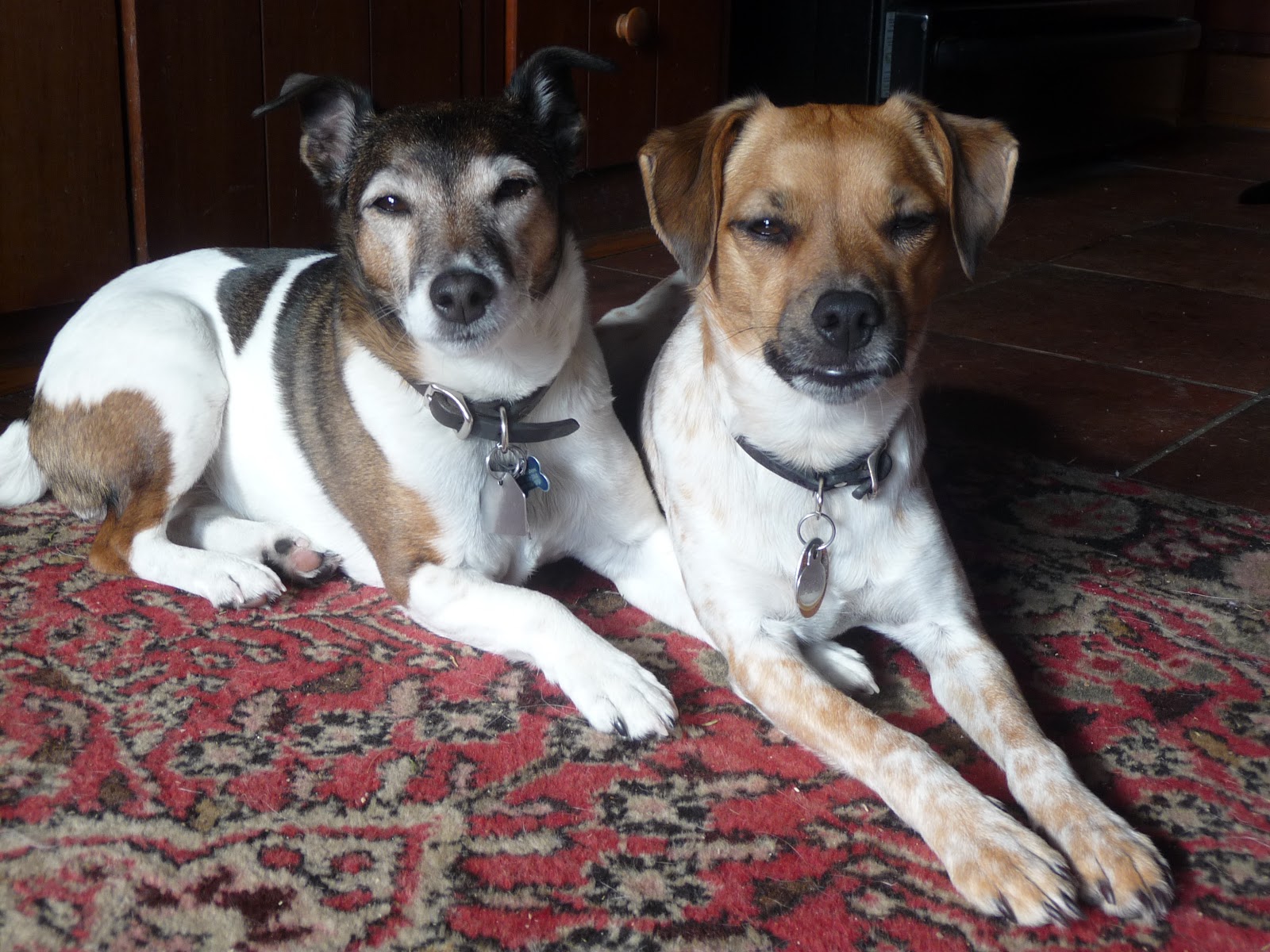
A week later, it is Christmas Eve and Spring and her dad have both gone to bed. But I am still unwinding from the night’s festivities. I help Santa stuff Spring’s stocking, tuck a couple of things into Fred’s and mine, and find gift bags for the dog toys. Poor old Spike’s Christmas present is a bag of tasty pill pockets. The Jack Russells will be sure to gratify us by finding their gifts, snuffling their noses into the bags, and digging out their new toys.


Then I pour myself a little Grand Marnier in one of the surviving delicate pink liquor glasses from my parents’ house, recalling the Christmas Eve I was allowed to sip my first crème de menthe—perhaps from this very same glass. I turn out all the other lights and sit a moment to sip, and savor the magic of the tree. Everything is done now: the baking, the cards, the making, the shopping, the wrapping, the decorating. Christmas can come in now.


But wait! The white light at the top of the tree under the angel is out! I shuffle to the cellar, find a new bulb, and unmindful of the glass of champagne I had a t Jeri and Ken’s house earlier and the Grand Marnier just now, climb the kitchen stool and screw in a new one.


It doesn’t work.


Doggedly, I return to the cellar for another. Yes! We have white light at the top of the tree, and an angel and stars!


There is one more sip in my glass. Not a creature is stirring. The little wild, double- stemmed spruce glimmers and glitters. Mum used to wrap all her gifts in shiny paper to enhance the shimmer. This year’s tree is truly beautiful—as always, the best one yet. But are there too many red lights? Should I put in a green one there, mid-way to the left? That’s it Susan! Sternly I send myself to bed and into Christmas future.

Monday, November 28, 2011

Apple Daze

Bubble Bubble, Toil and Trouble

Aching joints and endless scrubble

Bubble bubble, toil and pleasure

Fill the hold with apple treasure


The apples are in. Yesterday I finished a last task, canning five gallons of cider. Now, aside from taking stock of the rosy fruit crowding our fridge and root cellar, watching for those rotters that might spoil a whole box, and perhaps making another batch of applesauce, we are done. It was a bumper year for our little Toad Hill Orchard after two barren seasons. At last we feel like apple farmers. When the sun shines you make hay and when the orchard bears, you put away fruit—who knows what we will get next year.


When we bought our original thirty acres in 1980, there was a pair of big old apple trees in the little sloping field next to the road, a Baldwin and a Snow. The former is a venerable New England favorite cooking apple, the latter a crisp, luscious “eater” with snow white flesh and cherry red skin. We knew them from our years working in orchards in New Hampshire and the Champlain Valley. I can imagine the first settlers in Whitesville traveling out toe western New York with these two precious and essential apple trees which would eventually fill their cellars—as ours is filled this year.


Our second spring, we planted about thirty trees of many varieties to keep the two elder trees company. Hopefully the original chart is somewhere in Fred’s desk—the untidiness of which is only surpassed by mine. Perhaps one winter day I’ll take on the project of digging it out. Several of the trees are planted too closely and they all need to be pruned to accommodate ladders. Every spring for the fleeting few days that the trees are in bloom, we savor the ethereal scent and beauty, and hold our breaths hoping that frost and rain will hold off enough for the bees to do their work. It’s an organic orchard. We could improve our management, but we have never sprayed. We’ve had some good crops in past years, but nothing like this year.


We two fifty-eight year olds felt like we were in our twenties again, climbing ladders and limbs with one ratty old picking bag and a canvas shopping bag—until evening when aching joints reminded us of our age. Twigs tugged at my hair and leaves slipped down my shirt. Geese winged southward across the sky. Ravens circled overhead. Perfect apples are rare without chemical assistance. I tuck especially lovely ones into my jacket pockets. Sometimes I find one so irresistible that I crunch right into it on the spot. Eve had it right. Apples are definitely meant to be eaten. And there is nothing like picking apples on a bright autumn day. One afternoon Mom and Dad Beckhorn, both eighty-one, helped pick the lower branches, Dad from a lawn chair using his metal grabber. Later the two of them make and can a big batch of sauce in my kitchen. We reserved a sweetly laden little tree for my six Girl Scouts to pick to make into apple crisp for one of their meetings. I’ve made apple pie, kuchen, sauce, cider, and one batch of deep red crab apple jelly. The deer have been busily cleaning up drops and I’ve been giving our three horses armfuls of apples every day.


Fred has become a fanatic hard cider maker, traveling to western Massachusetts to attend workshops, and collecting wild fruit and special varieties to add to his blends. He went to Lains’ Cider Mill in Canisteo to press large batches, three times, some of which we sold fresh. He rebuilt our antique press to do small specialty mixes. (Unfortunately the grinder is horribly inefficient and it’s a bear to turn the handle, especially when grinding hard, small apples. But the exercise is great!) Now the cellar audibly gurgles with many yeasty, fragrant brews, one mixed with black currants, another purely from wild varieties.


There is an amazing difference in apples. One of our favorite findings this year is the pale yellow, thin skinned Calville Blanc D’Hiver (white winter). Our daughter Spring, home for the holiday weekend, made apple tart with it, crumbly with butter and ground almonds. Wow. Everywhere Fred goes, he spots wild trees—potential taste discoveries. I roll my eyes. I’m ready to be done with the harvest. With Spring, we pick up yet more small, hard, wild apples for her to make chutney. “That’s it!” I say, walking back to the car. “I am finished picking apples this year!” We drive up the driveway. It’s satisfying to see the trees bare except for a few stray apples that the deer and grouse will enjoy. High in the branches of the tall old Baldwin tree, the sun catches a tantalizing cluster of bright red fruit, enough for a couple of pies . . .


Monday, November 21, 2011

Wolves in the Neighborhood


Ah-roooooooooh, ah-roooooooooh! Ooooooooooooo . . .


There is no translating the sound into human language or writing. We share the same vocal range, but only Canis lupus comprehends the message in the undulating vowels, the drawn out, sweeping, or staccato rhythms, the rising and falling tones. The sound is riveting, joyous, sad, mysterious. It is the voice of wildness. Ever since I read Little House on the Prairie, Julie of the Wolves, and The Call of the Wild, I have longed to hear a wolf howl. On occasion I have heard my own tail wagging creature, who shares 98% of her genetic material with wolves, croon her own eerie little song, but it’s not the same.


Yesterday I heard wolves.


One of the things that I like best about cities is that they are fun and exciting to visit, but you can leave them quickly behind. Head north less than an hour from the Big Apple and you will find The Wolf Conservation Center. www.wolfconservationcenter.org. Yes, you are still in the suburbs, but here in 27 acres of hilltop forest, you can meet wolves that are part of a program which is working to bring Mexican red and gray wolves back from the brink of extinction, and which is educating people about the true nature of wolves. They won’t eat your grandma, but they will eat the slow, the weak, and the sick ungulates and help bring ecosystems back into balance.


Here in western New York, I can’t plant so much as a white pine tree without putting a cage around it to protect it from the ravenous, swollen deer herd. I love deer—precious dappled fawns, big eyed does, and heart stopping bucks silhouetted against misty pines—I love deer in healthy numbers, and deer on my dinner plate. Maybe we need a few more wolves back in their rightful place in the world.


It was an unforgettable day. I met “ambassador” wolves who are socialized to humans. The two yearlings Alawa and Zephyr, played in their enclosure, leaping, delighted and begging for treats and attention. The autumn sunlight glistened on their fur. Each wolfed down, in a couple of minutes, a chicken carcass that I might have stuffed for Sunday dinner, tenderizing it first in their powerful jaws. The elder wolf, Atka, visited aimiably, then lay down and posed as if he were expecting Ernest Thompson Seton to set up an easel nearby and paint his portrait. I glimpsed two rare Mexican grays in their wooded enclosure. If you “hack’ a captive born wolf pup into a wild wolf mom’s nest of pups, she will adopt it 100 percent of the time.


I’m sorry my computer wan’t read my photos today, but you can log onto the WCC website. The Wolf Conservation Center needs our help to win a $25,000. grant from the Chase giving Program. You can help if you are on Facebook by going to www.nywolf.org and clicking on the link on the left.


Ah-roooooooooh!

http://www.nywolf.org/